
- ホーム
- English
English
History of the Yokohama Nigiwai-za Theater
After the port of Yokohama opened to international trade, the city became a gathering place for goods, people, and cultures. As the movement of people increased, Yokohama, and mostly the Isezakicho area, became lined with the theaters and playhouses of storytellers that attracted throngs of people every day. Storyteller theaters (yose), believed to have first appeared around the middle of the Edo period (1603–1868), were popular entertainment halls that featured rakugo (one-person storytelling performances mainly involving humor) and kodan (one-person storytelling performances centered around historical facts or figures) shows.
However, after WWII, television and radio gradually replaced these forms of entertainment, and storyteller theaters and playhouses disappeared from the city of Yokohama.
Yokohama Nigiwai-za was established in 2002
in the Noge District of Yokohama as a facility that specialized in popular entertainment after Katsura Utamaru (1936–2018), a Yokohama-born and raised rakugo performer, petitioned the city of Yokohama to build a theater for storytellers in Yokohama. The term “popular entertainment” refers to the various forms of entertainment that include rakugo, kodan, rokyoku (a form of storytelling accompanied mainly by shamisen music), manzai (a form of entertainment in which two performers exchange conversations), acrobatics (acrobatic performances of spinning objects on umbrellas or throwing balls and rings), magic, and street performances.
Yokohama Nigiwai-za offers yose-style performances from the first to the seventh of each month. These yose-style performances alternate between rakugo and iromono (magic, acrobatics, manzai, etc.), which give audiences the chance to enjoy a variety of entertaining performances in a single session. Magic and acrobatics in particular can be enjoyed regardless of language barriers.
Yokohama Nigiwai-za will continue to partner with the district of Noge to remain a place where people can relax and be entertained, and where old traditions are passed on, and new performing arts are created.
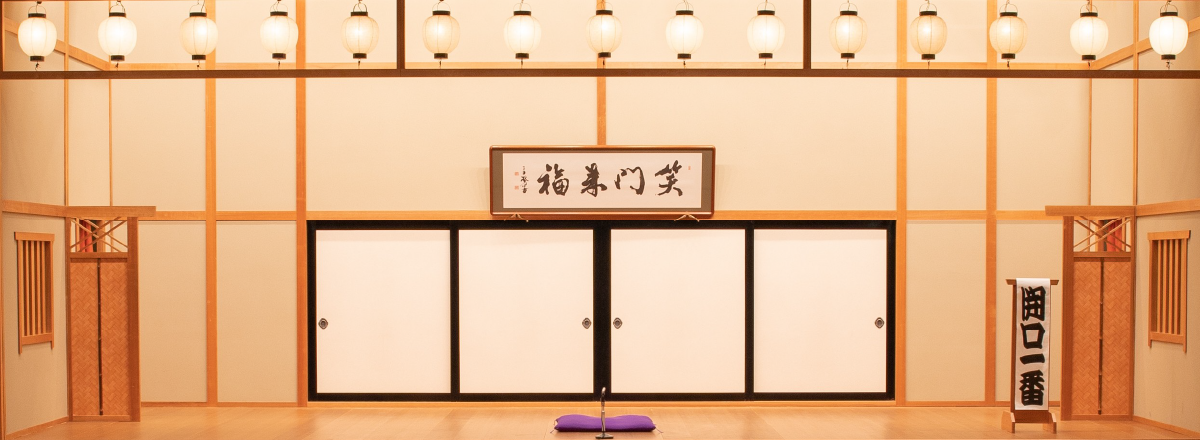
Facilities
Performing Arts Hall (391 seats)
This hall is equipped with an inexpensive box seating area in the upper gallery designed to create the perfect atmosphere for yose shows.
From the first to the fifteenth of each month, a variety of popular entertainment performances, mainly rakugo, are held on different days.
From the sixteenth to the end of the month, the hall is available for rent. The acoustics and yose enclosure make it particularly suitable for storytelling performances. In addition to popular performing arts, the hall can also be used for Japanese dances, theater performances, concerts, and more.
Noge Schale (small hall) (capacity: 141 people)
This space can be used for a wide range of activities, including dance, theater, and street performances. With a ceiling height over 5 m and a concrete floor, the hall can also be used for juggling and unicycle sessions.
Practice room
This is a place for practicing, rehearsing, and creating dances and other types of shows. The room is equipped with a wooden floor, a barre handrail and mirrors.
Art-production room
This space can be used for painting or practicing other crafts. The large washroom inside the room makes it suitable for activities that require water.